Hinterlands Canon Class of 2026: Part 2
Welcome back to the Hinterlands Canon Class of 2026!
If you don't know what the Hinterlands Canon is, check out Hinterlands Zine #1 (Available Here) for an overview and check out the list in its entirity here, or by clicking the link in the navigation bar at the top of the page.
If you haven't read Part 1 of the Class of 2026 coverage, check out the links to my other coverage below:
- Class of 2026 Blog Part 1
- Class of 2026 Blog Part 3
- Class of 2026 Blog Part 4
- The Hinterlands' 'Best Reads of 2025' Youtube Video
Presenting the Hinterlands Canon Class of 2026:
- The History of the Runestaff Series by Michael Moorcock - Hinterlands Zine #1
- Peace by Gene Wolfe - Review+
- Holy Fire by Bruce Sterling - Best Reads of 2025 Video
- Dhalgren by Samuel R. Delany - Best Reads of 2025 Video
- Roadside Picnic by Arkady and Boris Strugatsky - Best Reads of 2025 Video
- The Knight/The Wizard by Gene Wolfe - Best Reads of 2025 Video
- The Chronicles of Amber by Roger Zelazny - Class of 2026 Blog Part 1
- Berserk by Kentaro Miura - Class of 2026 Blog Part 1
- Nausicaä of the Valley of the Wind by Hayao Miyazaki - Class of 2026 Blog Part 1
- The Books of Earthsea by Ursula K. Le Guin - Class of 2026 Blog Part 2
- Delicious in Dungeon by Ryoko Kui - Class of 2026 Blog Part 2
- Fist of the North Star by Buronson and Tetsuo Hara - Class of 2026 Blog Part 2
- Red Mars by Kim Stanley Robinson - Class of 2026 Blog Part 3
- The Incal by Alejandro Jodorowky and Mœbius- Class of 2026 Blog Part 3
- Dorohedoro by Q Hayashida - Class of 2026 Blog Part 3
- The Martian Chronicles by Ray Bradbury - Class of 2026 Blog Part 4
- Hunter X Hunter by Yoshihiro Togashi - Class of 2026 Blog Part 4
- YuYu Hakusho by Yoshihiro Togashi - Class of 2026 Blog Part 4
The new inductees (Part 2 of 4):
The Books of Earthsea by Ursula K. Le Guin
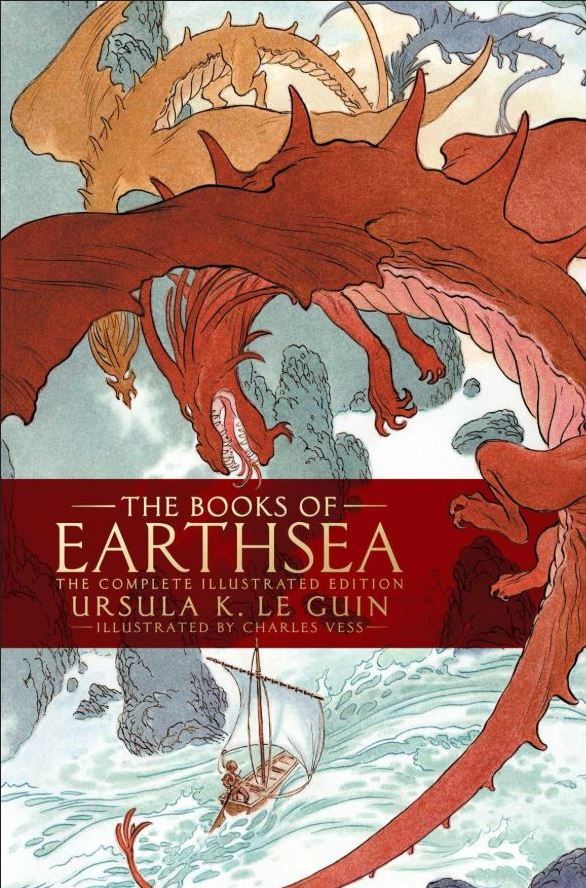
Ursula K. Le Guin's A Wizard of Earthsea was the result of a publishing house asking her if she would write a fantasy story aimed at younger readers. In the late 60s fantasy was a growing market, as the ripples created by the Lord of the Rings crashing into the pond of the publishing industry a decade earlier expanded ever outwards. The result of these circumstances, a writer being asked to write something to fit a market, led to Le Guin thinking deeply about what fantasy was and what it could be as she wrote her story. The book is both timeless in terms of narrative structure and innovative in terms of setting and approach, a book that feels fresh and special even today.
I read A Wizard of Earthsea as a kid and it didn’t leave much impression on me. My main memory of it was that it felt strange and uncanny, and that it didn’t sit comfortably with me the way my favourite books did. This, I realized as I got older, was a sure sign of a work that I should re-visit and re-examine. The friction of discomfort and the uncanny that I glossed over and didn’t understand how to process when I was a child and then a teenager has bcome a powerful attraction as an adult, awake and alert to the complexity and violence of the world, where things aren’t as simple as they had seemed in childhood.
I re-read the Books of Earthsea alongside the Shelved by Genre Podcast in 2024, reading the large illustrated edition released a few years ago. It was not surprising to me that they were great, (I had read and loved The Dispossessed as a 19 year old), but their poetry, artistry, and the way they laid out a holistic world of folk-tale inflected fantasy in the early days of the genre’s emergence from Science-Fiction’s shadow struck me powerfully.
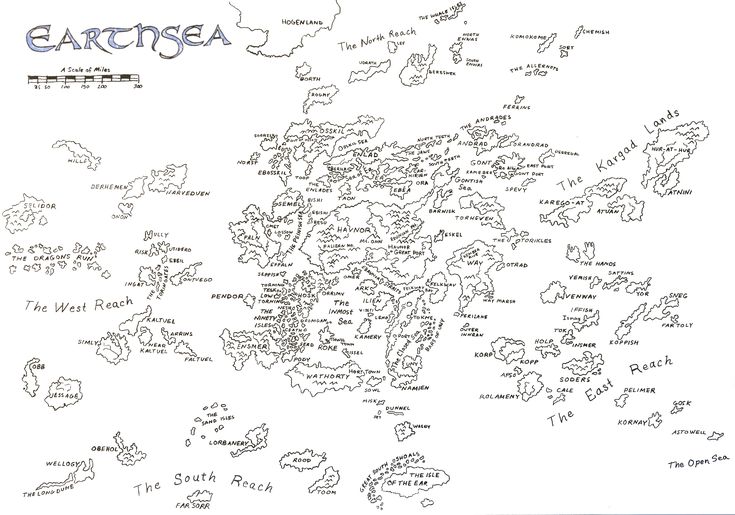
The two core appeals of Earthsea are first the unique setting, especially for the era, which is a world of small islands inhabited by largely dark skinned people. Despite the publishing world’s tendency to depict her characters as white on book covers, Le Guin created a world of non-white sailing people navigating between the many islands of Earthsea, fishers and traders, and on larger islands farmers and blacksmiths and soldiers. This focus on nautical skill as an everyday essential gives the setting a unique flavour, as among the traditional fantasy hero’s journey skills a young wizard must learn such as self-reliance, confidence, how to cast spells etc, our Ged must also learn how to set a sail, tie a knot, and keep a steady course beyond sight of land. This gives the setting a texture and materiality that sets it apart from the many iterations of fantasy medieval europe which fill the library of 20th century english language fantasy.
The second core appeal of Earthsea is the connection between magic and language, something that has become much more common in fiction today, and certainly was not invented by Le Guin. At its core the idea is as old as language itself: words are spells, spells of understanding between people at the very least, if not more. But her concept of magic as words spoken in the true tongue, words that are always true and so to speak them is to create the state of being that they describe (although the costs for trying to change too much are grave). To cast a spell is a search for the proper words, the proper phrasing, the just so inflection to create the world you wish without over reaching or generalizing, much like the act of writing fiction.
Each of the books is valuable and special in its own way (I quite enjoyed The Farthest Shore, even if the hosts of Shelved by Genre were lukewarm towards it at best), and here I will briefly mention the specific standout qualities of The Tombs of Atuan, Tehanu, and The Other Wind, which each offer something special, above and beyond the qualities that make the series as a whole worthy of inclusion.

The Tombs of Atuan tells a familiar story of a young woman in need of rescue by a valiant fantasy hero from an evil cult worshipping dark gods in an ancient labyrinth underground. However, in a now famous trick it reverses the perspective, telling the story of a young girl named Tenar, raised from birth in the dark places performing ancient rites to dark gods dead but dreaming. We watch her grow in this strange and insular religious society, her very presence a vestige of a different era. Her gods are long out of favour, but she is kept around to perform her rites in the shadows, out of an old and lurking fear of what happens when they are not given the offerings they demand. When tomb raider Ged stumbles into her labyrinth she throws her old life away to rescue him, and in so doing, saves herself.
Tehanu returns to the story of Tenar decades later, both in the fiction and in real time. Le Guin’s long thought about feminist issues over the time between led her to write a story of Tenar, now Tehanu, living the life of an ordinary woman in this low fantasy society, a world of agricultural toil and gendered labour and expectations. Tehanu is also the story of a small girl, traumatized, troubled, and physically scarred who needs support. This story breaks the mold of fantasy storytelling by emphasizing the everyday labour of the vast majority in the worlds of fantasy stories, in particular the specific labour and expectations heaped upon women. As always Le Guin is a master at creating a sense of place through tactile reality, and this realism inflected story works so well because of her skill.
Finally The Other Wind addresses the strange dark afterlife that has haunted Earthsea from the very first book, a land of infinite dry shadows where the dead wander lonely and filled with despair. Le Guin finds reparative hope in death, and tells the story as a fable of how all the worst excesses and evils of the world come from overindulgence of desire: desire for too much life, too much security, too much wealth, too much comfort. The corrupting violence that comes from grasping for these indulgences haunts us now more than ever.
Delicious in Dungeon by Ryoko Kui
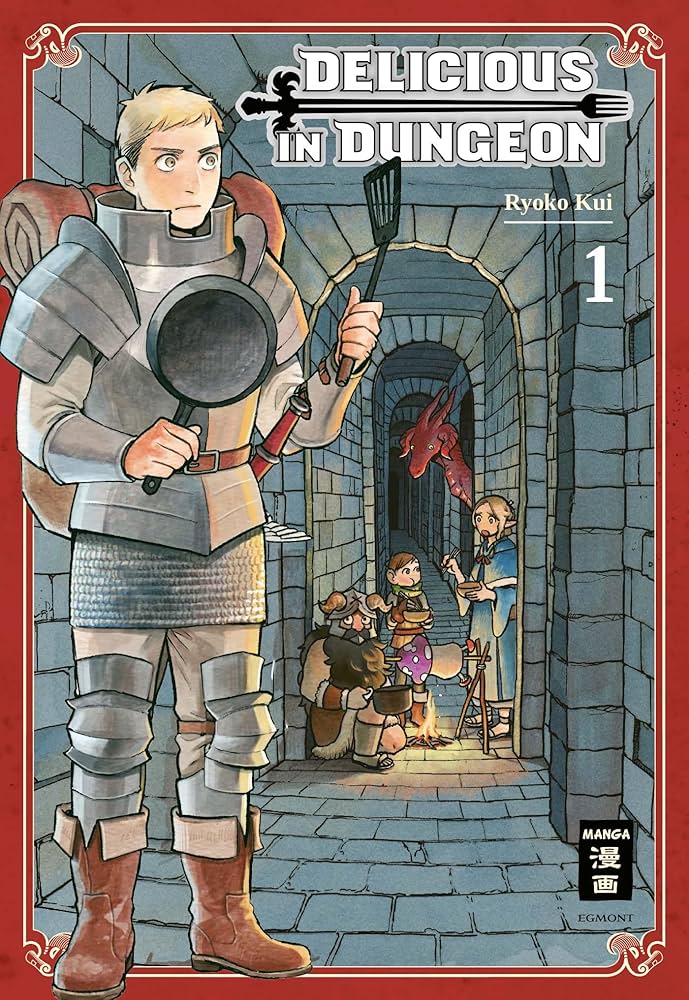
Ryoko Kui’s dungeon crawling meets cooking manga was a smash hit upon its english translation, after being picked up by word of mouth on social media. I can only imagine that its arrival in anime form on Netflix has put a force multiplier on that popularity. The appeal to me is fairly straightforward: - it is the most exciting and interesting literary depiction of the Fantasy Dungeon in the post D&D/videogame era. Dungeons and Dragons and decades of video games derived from it chewed up Lord of the Ring's Mines of Moria and other such inspiration and spat them out as well honed machines of interactable game space, filled with tropes based more on repeatable gameplay than any narrative or thematic value.
These fun but absurd constructions quickly take on troubling implication if you try to transform them back into literary spaces rather than game ones. The extractive logics commonly used as window dressing for gameplay loops look starkly monstrous and become difficult to reconcile with a coherent world. This has been a problem for fantasy fiction attempting to deal with the Wizardry model (a dungeon crawling video game very popular in Japan) in any kind of legitimate storytelling. Very often the stories using this form in comics tend towards comedy, parody, or irony, simply accepting the absurdity of the tropes and premise and commenting on them for comedic value. With Delicious in Dungeon ,Ryoko Kui has found incredible success by applying what is often described in the tabletop scene as Gygaxian Logic or Gygaxian Design to her dungeon. The dungeon is a real place, complete with ecosystems, food webs, relationships between the intelligent inhabitants, goals and motivations. Things are not just there for the convenience of the storyteller or the players, they have their own internal logic which makes the world feel real.
The Dungeon at the heart of the story successfully captures the sublime at the heart of the best dungeon stories in fiction. A place crafted by a once mighty people for some long lost purpose now fallen into ruin, but that ruin has cevome fertile ground for occupation by natural (and unnatural forces). If the once mighty halls of the Mines of Moria now crumbling and decaying, taken back by the inhabitants of the deep places of the earth are one extreme, then the other might be the majestic floating city of Studio Ghibli’s Castle in the Sky. Overtaken by the plants of its gardens, even the robot caretakers, once weapons of war, have become walking terrariums inhabited by lichen, birds, and small mammals. Ryoko Kui’s Dungeon weaves both of these strains of dungeon together, a fallen, sunken land where the ruins are both sad, frightening, and beautiful in the way that they’ve been appropriated into homes for living things. Think of the beautiful moment in Lord of the Rings where a fallen statue is being reclaimed by nature. Look Master Frodo, said Sam, that King has a crown again.
This interest in reinvigorating concepts that have been reduced to a grey paste of exhausted tropes by continual low effort deployment in video games and fantasy fiction alike extends beyond the dungeon and into the setting and expectations of the conventional fantasy world. You may be familiar with the “Fantasy Races”, Humans, Elves, Dwarves, Halflings, Gnomes, etc. Laid down by JRR Tolkien and then turned into a mechanical system by Gygax, Arnason, and co., these types of people and the stereotypes they embody are worn rather thin. Kui reinvigorates them by thinking about the world and cultures that might be produced by interactions of human-like groups that differ in terms of lifespan and preferred living environment. On top of that, Kui does a good job of crafting very unique characters that are have complicated relationships to the classic fantasy stereotypes of their respective groups, here reinterpreted as cultural norms rather than laws of nature. Senshi the dwarf never took to mining and lives in the dungeon cooking monsters rather than try to return to a culture he feels out of place within. Chilchuk the halfling is a deadbeat dad to three daughters at age 25 because halflings have short lifespans and are mature adults much younger than humans.
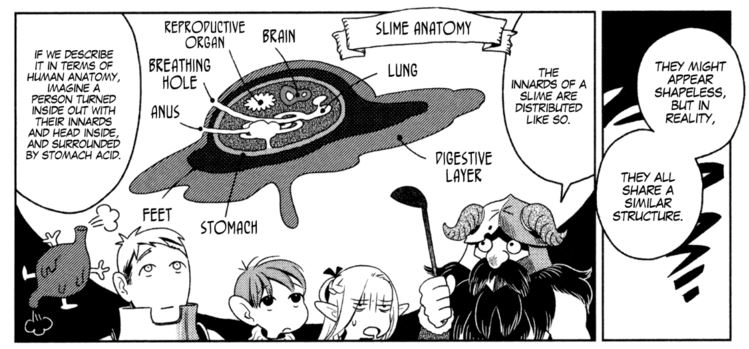
At this point, I should probably mention the cooking. To me the heart of Delicious in Dungeon is in the Dungeon, but the Delicious is also central to the storytelling and its appeal. To save resources on their journey to find the red dragon and rescue their fallen companion, the adventuring party learn to forage from the dungeon itself. To this end, classic RPG monsters are turned into legible biological entities where understanding their biology and life cycle is key to defeating them, and then, to cooking and eating them. There is a dual pleasure here, the grotesque thrills of unusual creatures being transformed into cuisine and the gentle pleasure of a story about food preparation among good friends. These contrasting emotions work well together, creating a central core that supports and structures the serialized bulk of the stories that make up the larger narrative.
Fist of the North Star by Buronson and Tetsuo Hara
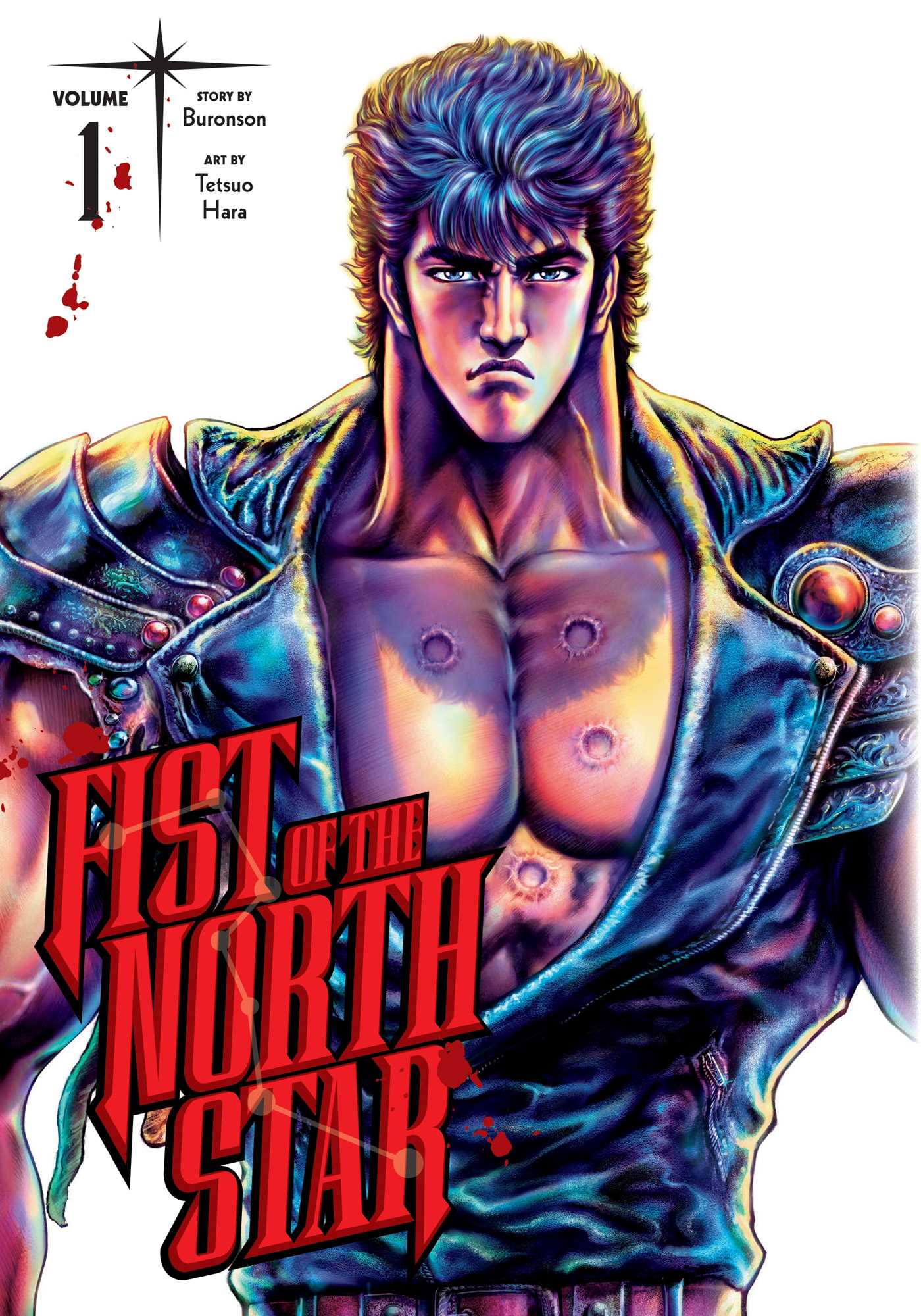
For basically my entire life, “shonen manga” (Japanese comics aimed at a target demographic of teen boys), have been written in the mold of Dragon Ball Z. These comics are based around characters who fight with special powers, with leads who grow over the course of "arcs" until they can finally defeat a major enemy. Naruto, Bleach, One Piece, Demon Slayer, Jujutsu Kaisen, Dadanrompa, pick your poison. All of these series, while altering this formula in key ways, are children of Akira Toriyama’s decision to evolve a comedy adaptation of Journey to the West into a serious science fiction battle story that proved to be one of the most influential works of popular fiction of our time.
But what did Shonen manga look like before Dragon Ball Z?
Atatatatatatata! Omae wa mō shindeiru*
*You are already dead
Before Dragon Ball Z, the pages of Shonen Jump were ruled by the journey of Kenshiro, rightful successor to the ancient martial art of Hokuto Shinken, through the post apocalyptic wasteland left after the collapse of society. In english, this comic is called Fist of the North Star. The contrasts between Dragon Ball Z and Fist of the North Star are many. Where Dragon Ball Z retains some of the light-hearted tone of its origins, Fist of the North Star is deathly serious. Where Goku and friends fight to protect the earth from destruction time after time, Kenshiro lives in a world that is already dead, and fights to protect the weak and vulnerable from those who would make themselves warlords of the ruins. Finally, the biggest and most important difference of all is that while Goku is frequently on the back foot, forced to maniacally train and reach deep inside himself to overcome his alien, robot, and lab-created adversaries, Kenshiro is (almost) undefeatable - his catchphrase (above) ‘You are Already Dead’ is frequently delivered to an opponent he has struck so quickly they don’t even realize they’ve been hit, and they will stand there laughing at Kenshiro before suddenly their organs explode from the inside in a gory display.
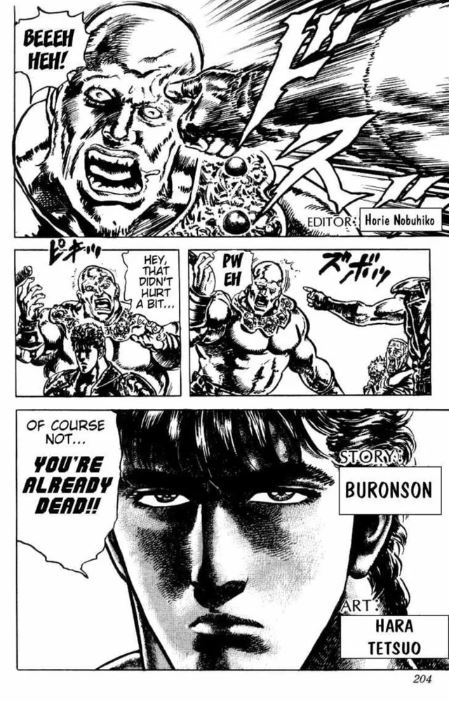
Conventional wisdom says that the Dragon Ball Z model of the protagonist always needing a stronger enemy to strive to defeat, growing and developing along the way. It says this is necessary to retain investment. We the reader won't have earned the pleasure of victory if there's no suffering along the way. This theory says that the era of Fist of the North Star, where heroes always won right away was inferior, replaced in a storytelling evolutionary arms race by a superior narrative style. While I love the storytelling of Dragon Ball Z, One Piece, etc the way it hooks directly into the Hero’s Journey delivery mechanism inside the human brain. However, this portraying of Fist of the North Star as simpler, less evolved, misapprehends how the series works. Instead of simply delivering the triumphant victory part of the story with no build up, Kenshiro’s delivery of swift brutal justice to evildoers is actually an inversion of the FIRST PART of the Dragon Ball Z arc. Every Dragon Ball Z arc starts with our intrepid heroes fresh off of becoming once again the strongest known beings in the universe, when they are suddenly confronted with a new threat that is somehow exponentially more powerful than them. It’s a raising of stakes, a moment of realizing you have misapprehended the state of the world and your overconfidence is about to teach you a brutal lesson.
The joy of First of the North Star is you get that story, over and over, delivered to a monstrous evildoer. Every time some enormous hulk hogan dressed like a Mad Max extra starts inflicting cruelties on the weak and helpless of the wasteland, soon they are confronted by a normal sized guy, who they laugh at and try to crush. Then, Kenshiro makes a few quick movements, so fast even the artist can barely capture them. For a moment or two more, the burly scumbag laughs with overconfidence, and then Kenshiro says his catchphrase. For one single, beautiful panel, the evildoer realizes his error, feels the intense pain he deserves - for a fraction of a second he suffers, and we get to see that moment of understanding. You have misapprehended the world. Then they explode from the inside out.
Fist of the North Star is a graphic story. I mean that both in the sense that it is told with images, but also in the sense that it is filled with comically exaggerated images of blood and gore. People are exploding constantly, limbs twist in horrific contortions, impossibly giant men rip bodies apart and inflict immense suffering with the slightest twitch of a meaty hand. On top of that the depictions of people are also grotesque in general, Tetsuo Hara marvelling in his ability to depict bulging veins and muscles swollen to comically distorted grotesquerie.
Ultimately the thing that makes Fist of the North Star so rewarding is that this unlimited violence is continually telling one story. The story of a fallen world where the powerful universally exploit and oppress the weak, and one man uses his fists to change that. Over the course of the story Kenshiro turns more and more people to his side and his quest to defeat his traitorous brothers and become the final and true inheritor of the Hokuto Shinken becomes a battle between ideologies. One ideology believes power exists to dominate and one ideology believes power exists to protect. That’s why it always feels good to see Kenshiro liquify another goon. The Fist of the North Star is the Fist of Justice.
NEXT TIME
In Part 3, we induct the first entry in a hard science fiction trilogy from THE END OF HISTORY, a legendary science fiction comic born from the ashes of a famous unmade film, and a different fantasy manga recently brought to wider attention by a netflix anime adaptation.
Link and Recommendations:
If you haven't read it yet my first Zine, Hinterlands #1, is available free on itch here.
My first ever booktube video is out! Watch it here!!!!
I accidentally took too many books out of the library so I've been reading those instead of blog posts - sorry! However I can happily recommend Annihilation by Jeff VanderMeer, and will be doing so repeatedly throughout the rest of the year.
Okay bye!