Behold the Man: A Review+
I am today a dedicated reader of Michael Moorcock. I came to be this way because of his fantasy work, and though this book is not fantasy, it contains a concentrated dose of the secret ingredient which makes Moorcock’s work so special. It’s a cheerfully bleak provocation that is both cynical and invested in the story of Christ, the relationship of history to fact and culture, and the ways that identity and ideology shape understanding.
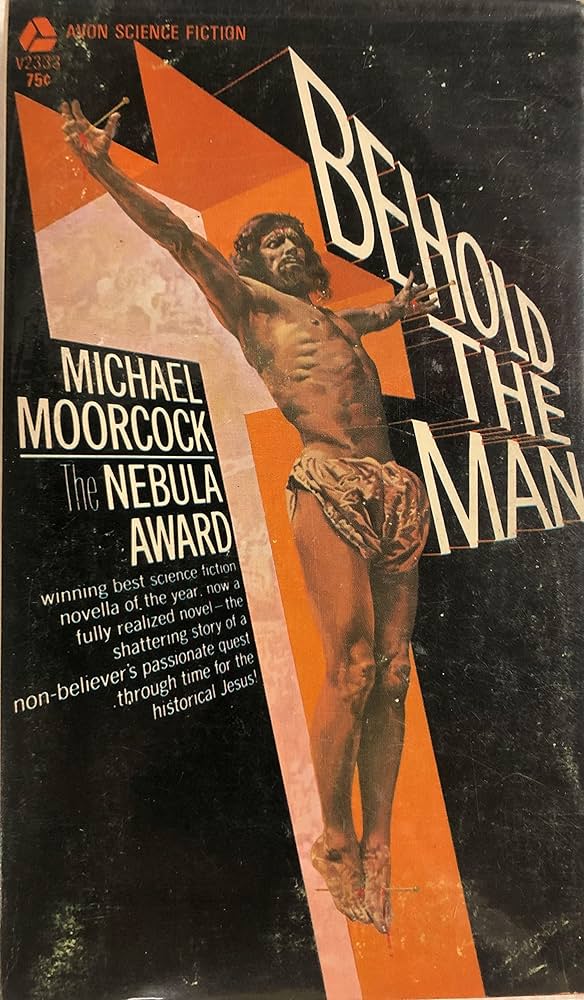
This is not the cover of my edition, but it's cool as hell.
That’s a lot of blather! What the hell am I talking about, you ask? Well Michael Moorcock’s Behold the Man is the story of a neurotic victim of childhood sexual abuse who grows up to be both extremely bad with women and a Jungian psychiatrist. He eventually goes back in time seeking the place of the Crucifixion and finding the historical Christ to be missing, becomes him instead. I spoil this for you because knowing the entirety of the story is the surest way to guarantee someone wants to read it, and I do recommend reading it. The book is a short 140 pages, you could read it easily in an afternoon, so why not?
Well, it’s not for everyone. Seekers of cozy escapism this is not for you! Our protagonist Karl Glougetter is a miserable child, a miserable man, and a strange avatar of all neurosis. He is an abused child, a closeted bisexual, a non-practicing Jew, a son of a single mother who finds himself unable to accept love and instead seeks out someone equally miserable who he feels he can look down upon and who will look down upon him in return. You can feel the simultaneous deep sympathy and loving contempt from Moorcock as he rains flaw and failure upon his poor suffering protagonist. For he will be the one to bear all of our suffering! All of our sins! Behold the man, the word made flesh, for he is the son of God.
The book opens with Karl having traveled back in time to the middle east shortly before the historical time Jesus is thought to have been crucified in Jerusalem. With a smattering of ancient Aramaic and Latin he picked up ahead of his journey, he manages to communicate with a group of religious commune dwellers (the Elamites) who rescue him and care for his wounds after the brutal journey. They bring John the Baptist to him, who begins to believe Karl is the awaited Messiah.
This goes along the way you might expect. Karl’s journey through the biblical middle east is told alternately with the story of his life up to the moment he travelled through time. His arrival segues into stories from his childhood, his adult education and first adult relationships are told as he leaves John and the Elamites behind, and the story of his final relationship which breaks him and sends him into the arms of the past is told alongside his taking on the role of the historical Jesus and fulfilling the mythical acts from the Bible.
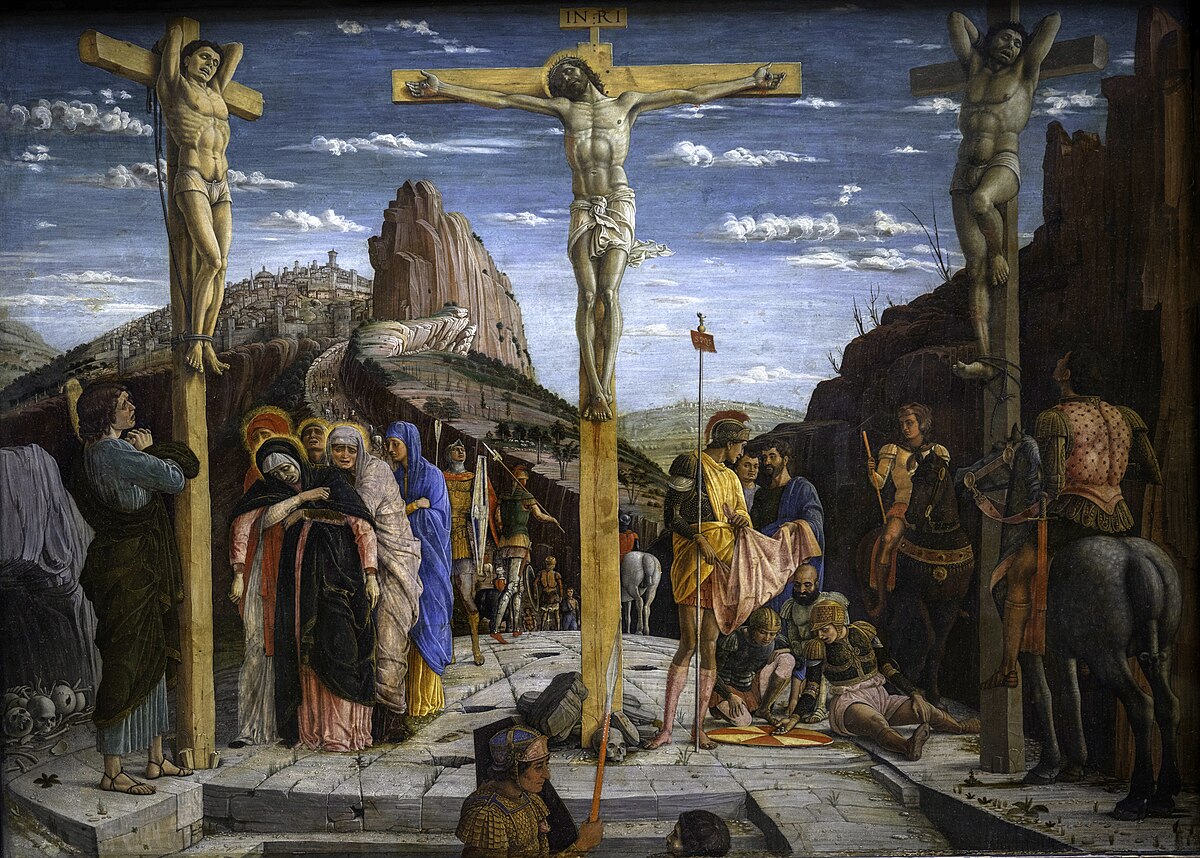
This is The Crucifixion by Andrea Mantegna, only one panel of a huge altarpiece now found at the Louvre
There’s a lot of discussion of history and psychology and it’s funny that Karl is such a dedicated Jungian when the story of his life as told by Moorcock takes on an extremely Freudian dimension. From his earliest relationships with sex and attraction he associates the cross with arousal, thanks to his dalliances with a young girl at church. Throughout the book women become silver crosses and men become wood crosses in his mind. He is sexually abused by a pastor, which leads to his traumatic relationship with bisexuality, something that lurks in the background of the story, but is never addressed directly. This is all in service of creating a character for whom being the subject of The Crucifixion would be the ultimate fulfillment, sexually and psychologically. Martyr complex and Fetishism all in one.
What I like most is the approach the story takes to history. The past is depicted as a real place full of real people with real human concerns. Judea is an imperial province of a distant empire, whose people are subjugated. They want to be free of occupation; they want to be free from oppressive taxes, and they want to be free to practice their religion. The depiction of John the Baptist is especially apt, carefully designing a man who is clearly a self-aware political actor who does not falsify his religious beliefs. John is given every appearance of truly believing his own words, but is also canny and apt politically. He thinks about the creation of narratives and how to influence people politically. He is not a naive actor, but someone calculating his actions to achieve a political goal.

Really good, incredibly bleak book. Very short, and I give it my full recommendation, with the caveat to check out the content warnings before you do.
A connection that occurred to me during and after reading is how the near misery-porn aspects of Karl’s life remind me of certain Japanese novels told from the perspective of self-loathing or materially suffering individuals. I’m thinking here first and foremost of No Longer Human (1948) by Osamu Dazai, which is narrated by a man who all his life feels isolated from other people and maintains a false exterior of pleasantness which hides deep internal pain and self-loathing, which he treats with alcohol and drugs before finally disappearing. Additionally, there’s the extremely strange novel The Box Man by Kobo Abe, about a man who lives inside a cardboard box, apart from society, and narrates his relationship to the world and the other people in it. Both of these novels feature protagonists who, due to their own internal perceptions of themselves and their alienation from society, feel themselves slipping inevitably towards a strange doom, that seemingly could be prevented if they could only change the way they think about themselves and those around them. This is where I see the similarity to Karl Glougetter, who pushes away the nice kind woman who tries to love him, and finds himself unable to separate from another woman later in his life despite their mutual cruelty to each other.
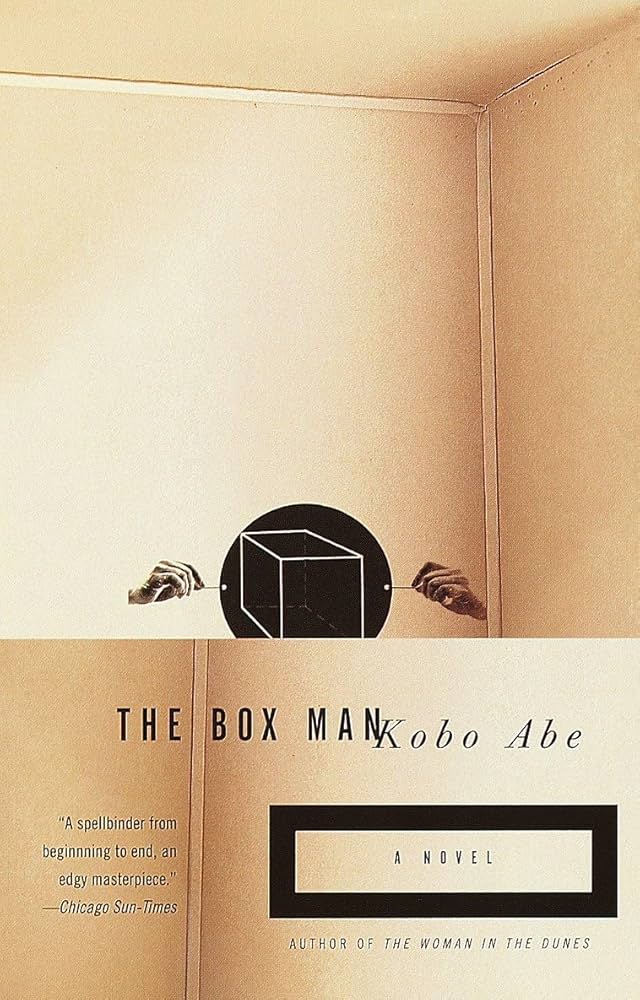
Incredibly weird book - I liked it a lot.
Some other novels that feel like they deal with this kind of obsessive misery, which Behold the Man can be put in conversation include All the Lovers in the Night by Mieko Kawakami, Tokyo Ueno Station by Miri Yu, The Universal Baseball Association by Robert Coover, and The Hour of the Star by Clarice Lispector. All of these novels are focused on a person’s internal perception of reality, their misery (or perhaps, our perception of their misery, whether or not they themselves feel miserable), and a downward spiral towards a dark fate which seems at once both inevitable and avoidable if the protagonist could only find another human being who they could truly confide in. Now not all of these books fit this exact mold, as some of them deal with poverty and physical misery, which cannot be avoided simply by having a confidant. As well, some of our characters manage to break out of the seemingly inevitable spiral towards doom. But all of these books feel like they belong in a modern international literary tradition of examining human misery.

Read this a couple years ago and I still think about it a lot - planning to write about it when the new edition is published next year.
Anyway - is Behold the Man an all time classic? I don't quite feel compelled to place it in the Hinterlands Canon, but I do recommend it as a wonderfully strange artifact, and if you, like me, have a taste for literary misery, give it a try.
Links:
A light set of links this week as I've fallen behind on my RSS reading, but I have a couple things to pass along.
The First Futurists and the World They Built:
My friend Jake wrote this great piece about the history of predicting the future, which I enjoyed.
The Castle Automatic:
I've made it no secret that I'm a huge fan of His Majesty the Worm, and so I'd be remiss not to link to the launch of a pre-order for the first official supplement for said game, a 100+ room, 5 level dungeon called The Castle Automatic. The link above is to a description of the dungeon itself on the Rise Up Comus blog. If you'd like to pre-order the book (as I have already done!) the link is HERE!
P.S.
As a special treat for anyone who was brave or bored enough to read this far, here are some updates on Hinterlands projects.
- I am working on a big overhaul for the website including some new pages, more stuff to look at and click on for the front page, and maybe some other odds and ends if I get that far.
- The Hinterlands Zine #1 has gone out to many of my friends in person and so very soon I will upload it to itch.io for free for everyone to enjoy
- Work on my next Zine project, Hinterlands Annual #1, proceeds, albeit much slower than I would like - I hope to have copies ready to distribute by the time some dear friends arrive in my home base for the holidays (not soon enough for Matt - sorry Matt - but keep an eye on your mailbox!)
- Big Hinterlands fans may know that on Bluesky in October I participated in something called Mörktober, for which I created a bunch of game tools and story fragments for the TTRPG Mörk Borg. At some point (ideally before the end of the year but hey, we'll see) I will compile those and put them up on itch in a pay-what-you-want capacity (0.00 is encouraged and expected).